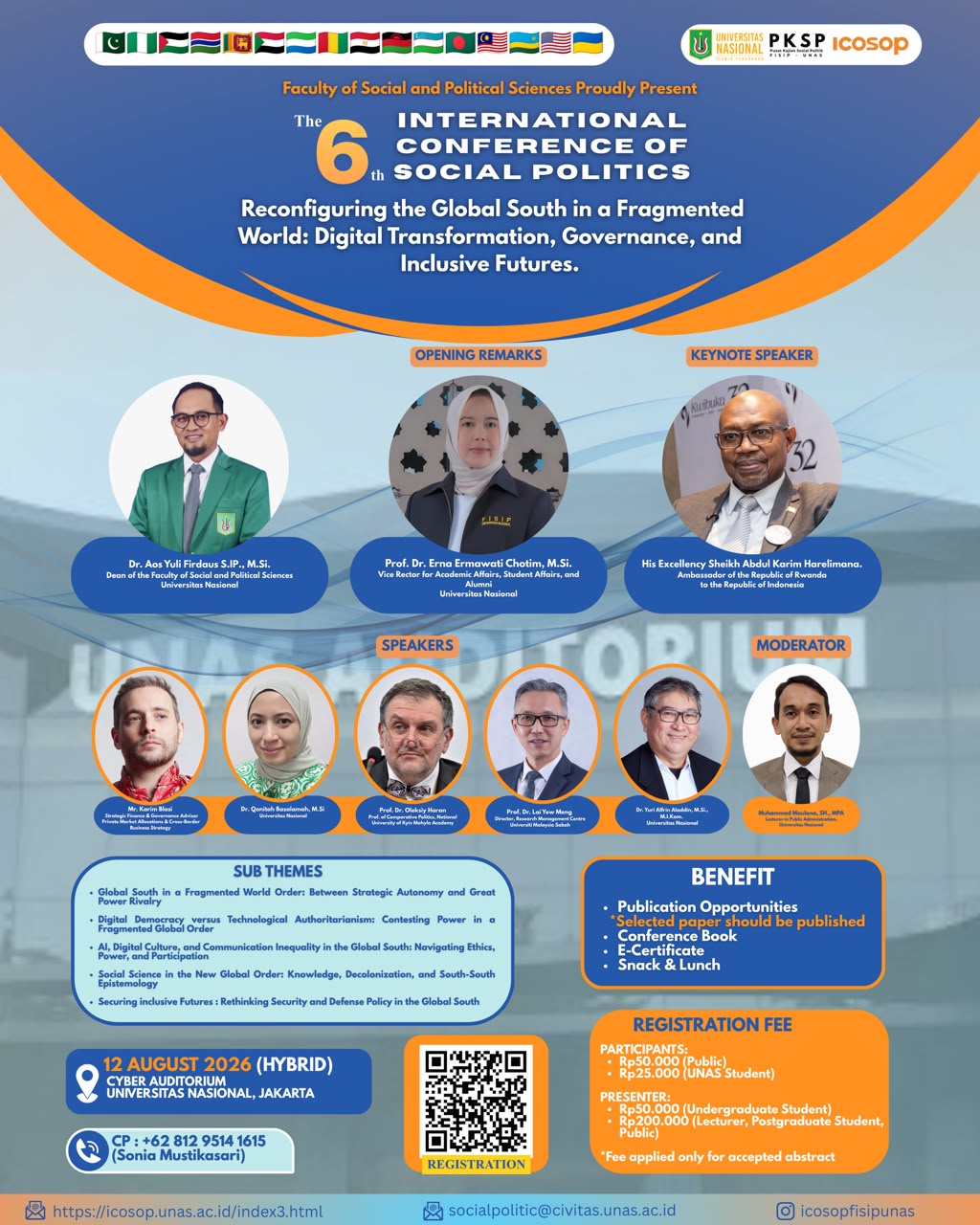
The 6th International Conference on Social and Politics

Reconfiguring the Global South in a Fragmented World: Digital Transformation, Governance, and Inclusive Futures.

About Conference

The 6th International Conference on Social and Political Sciences (ICOSOP 2026) will be conducted as an interdisciplinary academic forum that brings together scholars, researchers, policymakers, practitioners, students, and civil society actors from various countries and institutional backgrounds. The conference will consist of keynote speeches delivered by prominent scholars and experts, plenary sessions discussing contemporary global issues, and parallel panel discussions organized by each study program within the Faculty of Social and Political Sciences. Participants will have opportunities to present their research findings, exchange ideas, engage in critical discussions, and build academic and professional networks related to the conference theme. The conference is planned to be conducted in a hybrid format, allowing both offline and online participation to encourage broader international engagement and accessibility.

12th August’ 26

Important Date

  • Participant Registration :
    June 10 – June 25, 2026
  • Abstract Submission :
    June 30, 2026
  • Notification of Acceptation / Rejection :
    July 10, 2026
  • Full Paper Submission :
    August 3, 2026

CONFERENCE OBJECTIVES

The Conference Aims To :

  • Facilitate interdisciplinary discussions on the changing dynamics of the Global South in the contemporary fragmented world order.
  • Examine the impacts of digital transformation on governance, democracy, communication, security, development, and social inclusion.
  • Promote critical reflections on strategic autonomy, geopolitical rivalry, and South–South cooperation.
  • Encourage the development of inclusive and sustainable policy frameworks for countries in the Global South.
  • Strengthen international academic collaboration among scholars, researchers, and institutions.
  • Provide opportunities for academics and young researchers to present and publish their research findings.

SUB-THEMES / PANEL DISCUSSION

A. International Relations Panel

“Global South in a Fragmented World Order: Between Strategic Autonomy and Great Power Rivalry”

This panel discusses how states in the Global South navigate geopolitical competition, economic dependency, regional cooperation, and strategic autonomy amid intensifying great power rivalry.

Possible Topics:
  • U.S.–China rivalry and its implications for the Global South
  • Strategic autonomy and middle power diplomacy
  • South–South cooperation and alternative multilateralism
  • Global governance and institutional reform
  • Digital geopolitics and technological sovereignty
  • Climate diplomacy and energy transition politics
  • Critical minerals, supply chains, and green geopolitics
  • Development financing and infrastructure competition
  • Regionalism and ASEAN centrality
  • Global security and emerging technologies

B. Political Science Panel

“Digital Democracy versus Technological Authoritarianism”

This panel examines the contestation between democratic governance and authoritarian technological control in the digital era.

Possible Topics:
  • Digital democracy and civic participation
  • AI governance and political power
  • Surveillance technologies and authoritarianism
  • Electoral disinformation and digital propaganda
  • Social media and political polarization
  • Cyber politics and digital sovereignty
  • Human rights in the digital age
  • Platform governance and regulation
  • Digital activism and resistance movements
  • Democracy and algorithmic governance

C. Communication Studies Panel

“AI, Digital Culture, and Communication Inequality in the Global South”

This panel explores AI, digital communication, media culture, and inequality in the Global South.

Possible Topics:
  • AI and media transformation
  • Digital divide and communication inequality
  • Ethics of AI and digital communication
  • Platform capitalism and media power
  • Digital culture and identity politics
  • Misinformation and information disorder
  • Influencer culture and digital labor
  • Communication rights and media inclusion
  • Algorithmic bias and representation
  • Public communication in the AI era

D. Sociology Panel

“Social Science in the New Global Order: Knowledge, Decolonization, and South-South Epistemology”

This panel critically reflects on knowledge production and social transformation in a global context.

Possible Topics:
  • Decolonizing social science knowledge
  • South–South epistemology
  • Global inequality and social transformation
  • Gender, labour, and global production networks
  • Digital society and social exclusion
  • Urban inequality and inclusive cities
  • Migration and transnational communities
  • Youth, identity, and cultural politics
  • Environmental justice and sustainability
  • Social movements and collective action

E. Public Administration Panel

“Securing Inclusive Futures: Rethinking Security and Defence Policy in the Global South”

This panel discusses evolving approaches to security, governance, and public policy.

Possible Topics:
  • Human security and inclusive governance
  • Defence policy in the digital era
  • Cybersecurity and national resilience
  • Disaster governance and climate security
  • Public sector innovation and digital governance
  • Smart cities and public administration
  • Security sector reform
  • Border governance and migration management
  • Health security and pandemic governance
  • Public policy and sustainable development

CONFERENCE FORMAT

The 6th International Conference on Social and Political Sciences (ICOSOP 2026) will be conducted as an interdisciplinary academic forum that brings together scholars, researchers, policymakers, practitioners, students, and civil society actors from various countries and institutional backgrounds. The conference will consist of keynote speeches delivered by prominent scholars and experts, plenary sessions discussing contemporary global issues, and parallel panel discussions organized by each study program within the Faculty of Social and Political Sciences. Participants will have opportunities to present their research findings, exchange ideas, engage in critical discussions, and build academic and professional networks related to the conference theme. The conference is planned to be conducted in a hybrid format, allowing both offline and online participation to encourage broader international engagement and accessibility.

VENUE AND DATE

The 6th ICOSOP will be held on :

  • Date

    12th August 2026

  • Time

    08.00 – 17.30 Western Indonesia Time (Jakarta)

  • Venue

    Cyber Auditorium National University of Jakarta (UNAS), Universitas Nasional of Jakarta, Sawo Manila No.61 Street, Pasar Minggu, Pejaten, Jakarta Selatan.

Cyber Auditorium UNAS

EXPECTED PARTICIPANTS

The conference activities are open to academics, researchers, policymakers, activists, lecturers, and students who have an interest in the above-mentioned sub-themes. Participants are also welcome to present new ideas that are not covered by the sub-themes and form their own panels with their colleagues by proposing them to the panel committee. Each participant can form a panel with a minimum of 4 panelists and a maximum of 5 panelists, who will discuss the theme proposed in the panel proposal. We also offer limited opportunities for general participants to attend the conference, excluding presenters The requirements for participants to engage in this conference are as follows :

  • Participants can be individuals, groups, or institutions.
  • Participants must submit an abstract with a chosen panel sub-theme, with a maximum of 100-150 words, which should include research questions, methodology, and main ideas.
  • The abstract should be accompanied by a brief profile, institution, and participant's email address.
  • If the participant proposes the formation of a panel, the panel abstract should also be accompanied by abstracts from each participant who will join the panel.
  • The committee will announce the selection results through the conference website and participants' emails. Selected participants must submit their presentation materials and full papers.
  • The abstracts will be published in the conference proceedings and the journal published by Faculty of Social and Political Sciences, National University of Jakarta, and are directed to be submitted to the Journal. Conference participants will receive certificates according to their involvement.

EXPECTED OUTPUT

The conference is expected to generate meaningful academic and policy-oriented contributions concerning the challenges and opportunities faced by the Global South in an increasingly fragmented global order. Through interdisciplinary discussions and scholarly exchanges, the conference seeks to produce critical insights, innovative perspectives, and collaborative research initiatives related to digital transformation, governance, strategic autonomy, inclusion, and sustainable development. In addition, the conference aims to strengthen academic networks and institutional partnerships among researchers, universities, and organizations at both national and international levels. The discussions and findings presented during the conference are also expected to contribute to policy recommendations and future research agendas addressing contemporary social, political, and technological issues affecting societies in the Global South

PUBLICATION OPPORTUNITIES

Selected papers presented at the 6th International Conference on Social and Political Sciences (ICOSOP 2026) will have the opportunity to be published in conference proceedings and several academic journals that collaborate with the conference committee, subject to the editorial policies and peer-review processes of each journal. The conference collaborates with The IIUM Journal of Human Sciences, The Journal of Area Studies (AJAS), and Journal of Social Political Sciences (SINTA 4 Accredited Journal). These publication opportunities are intended to support the dissemination of high-quality interdisciplinary research related to the conference theme and sub-themes, particularly studies addressing issues of digital transformation, governance, geopolitics, communication, social change, security, and inclusive development in the Global South. Through these collaborations, ICOSOP 2026 aims to strengthen international academic engagement, encourage scholarly exchange, and contribute to broader global discussions within the fields of social and political sciences.

Speakers

Opening Remarks
icon

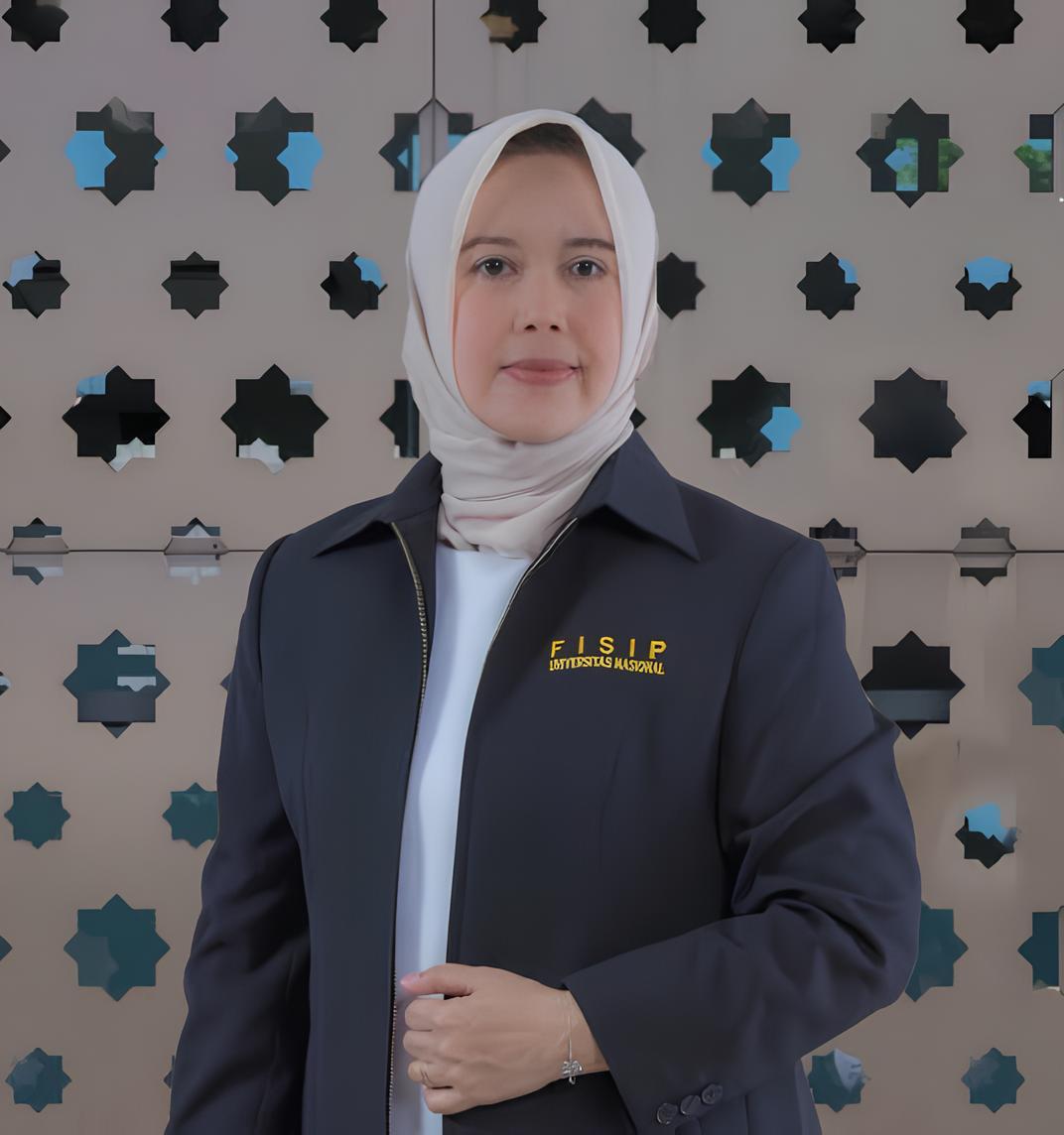
Assoc Prof. Dr. Erna Ermawati Chotim M.Si

Vice Rector of Academic, Student affair, and Alumni

Welcome Speech
icon

Assoc Prof. Dr. Aos Yuli Firdaus, S.I.P, M.Si.

Dean of Social and Political Science of Universitas Nasional, Indonesia

Keynote Speaker

Opening Remarks
icon

Get Inspired

Lorem ipsum dolor sit amet, consectetur adipisicing elit, sed do eiusmod tempor dunt ut labore et dolore magna aliqua. Ut enim ad minim veniam.

Opening Remarks
icon

Networking Session

Lorem ipsum dolor sit amet, consectetur adipisicing elit, sed do eiusmod tempor dunt ut labore et dolore magna aliqua. Ut enim ad minim veniam.

06

Meet New Faces

Lorem ipsum dolor sit amet, consectetur adipisicing elit, sed do eiusmod tempor dunt ut labore et dolore magna aliqua. Ut enim ad minim veniam.

CLOSING STATEMENT

The 6th International Conference on Social and Political Sciences (ICOSOP 2026) is envisioned as an important academic platform for fostering critical dialogue, interdisciplinary collaboration, and international scholarly engagement in response to the increasingly fragmented global order. As digital transformation, geopolitical rivalry, governance challenges, and social inequalities continue to reshape the world, the Global South occupies a strategic position in determining the direction of future global development and cooperation. Through the conference theme, “Reconfiguring the Global South in a Fragmented World: Digital Transformation, Governance, and Inclusive Futures,” the conference seeks to encourage meaningful discussions and innovative perspectives that address contemporary global challenges while promoting inclusion, sustainability, and social justice. By bringing together academics, researchers, policymakers, students, and practitioners from diverse backgrounds and countries, ICOSOP 2026 is expected to strengthen international academic networks and encourage collaborative research across disciplines. The conference also aspires to contribute not only to academic advancement but also to the formulation of practical and policy-oriented solutions relevant to societies in the Global South. Through keynote sessions, panel discussions, research presentations, and publication collaborations, the conference aims to create a productive intellectual space that supports the development of inclusive and sustainable futures in an era of rapid global transformation. In conclusion, the 6th International Conference on Social and Political Sciences (ICOSOP 2026) represents a strategic initiative to examine the changing dynamics of the Global South amid global fragmentation, technological disruption, and evolving governance structures. The conference provides a valuable opportunity for interdisciplinary engagement and scholarly exchange concerning issues of strategic autonomy, democracy, digital transformation, communication inequality, decolonization of knowledge, security, and inclusive governance. By facilitating dialogue among scholars and practitioners from various fields, the conference is expected to generate critical insights, strengthen academic cooperation, and contribute to the advancement of research and policy discussions in social and political sciences. Ultimately, ICOSOP 2026 aims to reaffirm the importance of collaborative knowledge production and international cooperation in addressing contemporary global challenges. The conference is expected to contribute meaningfully to the development of innovative ideas, inclusive policies, and sustainable approaches that can support the empowerment and resilience of societies in the Global South within an increasingly complex and interconnected world.